
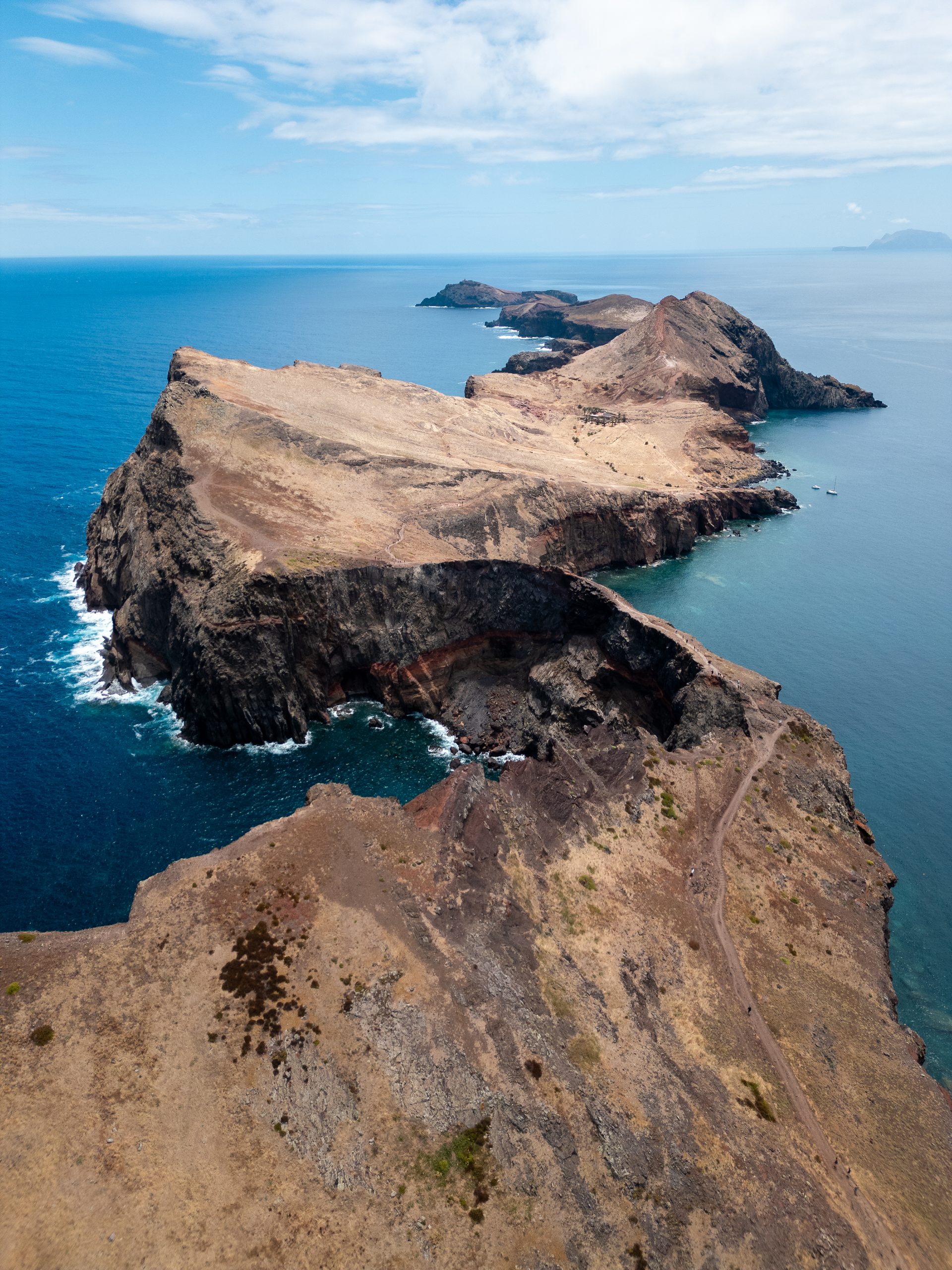
Planning a Madeira 7 day itinerary? You have come to the right place. I recently visited Madeira and covered most of the island, including where we stayed, what we did each day, the places we loved most, and what I would recommend booking ahead if you’re planning your own trip.
Madeira is one of those places that looks Photoshopped until you’re standing in it. Volcanic cliffs drop straight into the Atlantic, sub-tropical gardens sit a twenty-minute drive from black lava pools, and mountain peaks poke above the clouds. It’s a lot of island for somewhere you can drive across in under two hours.
We visited Madeira for our anniversary. There are two ways most of the travellers tend to book their accommodation. You can either base yourself entirely in Funchal and drive to different parts of the island, or you can split your stay across multiple locations, which drastically reduces the travel time.
We did the latter and based ourselves in three different locations, which genuinely turned out to be the right call. The island changes completely depending on which coast you’re standing on, and seven days is just about long enough to see why.
Here’s our full Madeira 7 day itinerary:
Getting to Madeira
You fly into Cristiano Ronaldo Madeira International Airport (FNC), one of the more dramatic runways in Europe, built on stilts over the sea. So don’t be alarmed by the approach.
FNC is widely known for its challenging approach due to strong crosswinds, mountainous terrain and its dramatic ocean-side runway. Don’t be alarmed if there is turbulence during the approach, and flights do sometimes have to circle or divert if the conditions aren’t suitable for landing.
We travelled from London, and direct flights run from most major UK airports. It took us roughly 4 hours from London.
Hiring a car is non-negotiable. We hired a car directly from the airport as it was the most convenient option for us. We hired through SIXT, but you can use Discover Cars or Booking.com to compare different rental companies and find cheaper options.
For the type of car, I would highly recommend something small but powerful, like a hatchback with a 1.2L engine or above for the inclines, or a compact SUV if you have more than two people. It’s also advisable to have full car cover and breakdown cover.
Madeira’s public transport doesn’t really reach the west or north coasts, and driving between the different bases is part of the experience. The roads are steep, tunnelled and occasionally hair-raising, but generally well maintained. Give yourself more time than Google Maps suggests, especially when driving through the mountains.
Best Time to Visit
We went in July, when temperatures were warm, reaching the high 20°C. The weather was dry, with long days for hikes, levada walks and lava pool swims.
The trade-off is that levada water flow is lowest during summer. If waterfalls are a priority, spring, especially April to June, is worth considering.
Madeira is a year-round destination thanks to its microclimates. July gave us reliable weather across all three coasts, which helped when driving between different parts of the island.
Madeira 7 Day Itinerary: Where to Stay
Most people staying in Madeira for a week base themselves in Funchal and take day trips from there. Honestly, this works well for exploring much of the island. We chose to split our week across three bases instead, purely to cut down on driving. Some of the best spots, including the lava pools, levada walks and Pico Ruivo trailhead, are over an hour from Funchal. Staying in different parts of the island meant less time in the car after already-long days.
If you’d rather keep it simple, Funchal-only works – you’ll just have longer drive times built into a few of the days below. Here’s how we split the week:
- Porto Moniz (2 nights) – the wild north-west tip of the island. Dramatic coastline, natural volcanic lava pools, and your base for adrenaline activities and the northern levada walks. We stayed at Aqua Natura Bay.
- Ponta do Sol (2 nights) – south-west coast, one of Madeira’s sunniest microclimates. Quieter, more residential, and the best jumping-off point for the central mountains. We stayed at Enotel Sunset Bay.
- Funchal (3 nights) – the capital, for your final stretch. City energy, old town nightlife, and everything within walking distance after a week of mountain driving. We stayed at Suite Hotel Jardins da Ajuda.
Madeira 7 Day Itinerary
Day 1: Arrival & Porto Moniz Lava Pools
We started Day 1 by driving to the north coast of Madeira from Madeira Airport to Porto Moniz. It’s around a 1.5-hour drive from the airport. The drive is pleasant, with good, wide roads, and should be a comfortable journey. You’ll also get your first views of Madeira’s beautiful volcanic mountains along the way.
We booked our stay at Aqua Natura Bay, which gave us a great central location to explore everything nearby. Porto Moniz is famous for its stunning natural lava pools. You won’t find many lava pools as beautiful as these in Madeira.
Check in at Aqua Natura Bay and take some time to settle in before heading out to explore the famous natural lava pools.


For sunset, drive to Miradouro da Ponta da Ladeira, famous for its sunset views and one of the best viewpoints around Porto Moniz. Arrive around golden hour for beautiful views along Madeira’s dramatic north coast.


Practical info:
- Lava pools entry: €3pp. Entry is free if you’re staying at Aqua Natura Bay or Aqua Natura Madeira.
- Aqua Natura Bay also has its own rooftop swimming pool with Atlantic views if you want a quieter dip before or after visiting the natural pools.
Day 2: Fanal Forest, Ribeira da Janela Swing & Adrenaline X-Treme
Have an early start from the hotel and drive straight to Fanal Forest. It’s around a 30-minute uphill drive from Porto Moniz. There is free parking at Fanal Parking, RV54+G9, Seixal, Portugal, along with a small toilet. There are no cafés or restaurants nearby, so pack some snacks and drinks with you.
Fanal Forest is a misty, centuries-old laurel woodland on the Paúl da Serra plateau. It’s famous for its fog-wrapped trees, and we were really hoping to catch the fog ourselves. Unfortunately, it just didn’t show up on the day we visited.


While coming back from Fanal Forest, stop at Ribeira da Janela viewpoint to see the famous swing overlooking Madeira’s dramatic north coast. The viewpoint is an easy stop and offers some of the best coastal views in this part of the island.


If you’re not an adventure person, you can skip the next activity and head back to the hotel for a relaxing day. You can spend the afternoon exploring the Porto Moniz coast and swimming in the natural pools.
We had this adventure on our list for a very long time. It’s the famous Madeira Giant Swing and zipline, provided by Adrenaline X-Treme Adventures. The swing sits around 250m above the Atlantic, while the 1.6km zipline runs from Ribeira da Janela towards the sea, passing over valleys, gorges and subtropical forest.
If you’re doing both, I would recommend booking the combo rather than choosing only one. It does take a considerable amount of time if you want to capture your adventure for Instagram using an Insta360, as there are limited devices available.
For dinner, we booked ourselves a table at Natural Pools Beer House, which offers great sunset views of the natural pools.
Practical info
- Fanal Forest is a short drive up from Porto Moniz onto the Paúl da Serra plateau – fog is common but not guaranteed, so don’t bank the whole visit on it.
- Adrenaline X-Treme Adventures: Giant Swing €39pp, Zipline €69pp, or €89pp for both as a combo – book ahead in summer.
Day 3: Seixal Sunrise, Achadas da Cruz & the Coast Road to São Vicente
Start your day by visiting Seixal Beach, one of the most beautiful black sand beaches in Madeira. The black sand comes from the island’s volcanic origins, and the beach looks completely different from the other beaches around Madeira.
We got up before dawn for sunrise at Seixal, which was one of our favourite stops on the trip. The black volcanic sand is backed by dramatic cliffs, with waterfalls flowing down from the hills behind. Getting there early meant we had the whole stretch of beach almost to ourselves.


Next, we headed to Espaço Infinito, which was a short walk from the car park. It’s a quiet, free viewpoint just outside Seixal, with beautiful views of the coastline and waterfalls. It’s worth stopping here for the view alone.


Back at the hotel, we freshened up and checked out before heading west to Achadas da Cruz. Here, we took the cable car down around 450m of cliff face to the fajã below. The area is made up of terraced farmland, vineyards and old stone storage huts, ending at a quiet pebble beach.
The cable car ride itself is worth the stop, especially for the views as you descend towards the coast.


From there, we drove along the coast towards São Vicente, stopping at Miradouro dos Ilhéus da Ribeira da Janela for views of the rock islets just offshore. We then continued through the Túnel Água d’Alto, Madeira’s famous single-lane coastal tunnel between Seixal and São Vicente.


Our next stop was Véu da Noiva, also known as the Bridal Veil waterfall. From the viewpoint, you get a beautiful view of the waterfall dropping down the rugged coastline.


We then continued to Miradouro de São Cristóvão in São Vicente before driving to Ponta do Sol to check in at Enotel Sunset Bay.


The hotel is right in front of the beach, which makes the location hard to beat. We also loved waking up to beautiful sunrise views from the hotel. If you’re an early riser, you can start your morning with a swim before heading out for the day.
Day 4: Levada Walks & Sunset in Ponta do Sol
We started the day with the Levada do Moinho and Levada Nova circular trail, starting right from Ponta do Sol. We deliberately started on the Moinho side rather than Nova, as the Nova section is noticeably steeper.
Doing the route in this direction makes the steep section downhill, which is much easier on the legs. If you start from Nova and finish via Moinho, you’ll have a much harder climb.
It’s a genuinely beautiful walk, with narrow levada paths cut into the cliffside and views dropping away on one side. There are a couple of exposed sections along the way, so take your time.
Near the end of the loop, on the Nova side, you reach the highlight of the walk. There’s a waterfall with the path carved behind the water, so you actually walk through the spray rather than around it.
Just before the waterfall, you’ll pass through a 200m tunnel. It’s pitch dark inside, so bring a torch or use your phone light.
The full loop is around 8km and took us roughly 3 hours.


After the walk, we freshened up and stopped for lunch on the beachfront in Ponta do Sol before continuing towards Fajã dos Padres.


Fajã dos Padres is a clifftop fruit plantation near Câmara de Lobos, reached by a cable car that drops around 300m down to the shore.
The weather wasn’t great when we visited, so we skipped the cable car. If conditions are good, it’s worth heading down to explore the banana, papaya and passion fruit plantations. There’s also a restaurant by the water where you can stop for a drink or lunch with views of the sea.
For dinner, we booked Sol Poente in Ponta do Sol. The views over the coast are genuinely some of the best we had all week.
If you have some extra time before dinner, Cascata dos Anjos is also worth a stop. It’s a small waterfall that tumbles directly over the old coastal road nearby. It gets busy around sunset, when everyone comes for photos, so go earlier if you want a quieter visit.
Day 5: Santana, PR 1.2 & the Stairway to Heaven
We started our day by driving to Santana via São Vicente. It’s around a 1-hour drive from Ponta do Sol.
Santana is situated on the north coast and is known for its traditional palheiros, small triangular, thatched A-frame houses that look like something out of a fairytale. It’s a quick and easy stop before heading into the mountains, and a nice contrast to the afternoon hike ahead.


Next, we stopped at Miradouro da Rocha do Navio, a viewpoint just outside the village with dramatic views over the coastline below.


From there, we drove up to Achada do Teixeira parking, which sits at around 1590 m, to start the hike. There is a large car park at the top, but parking can be difficult during peak season when there are lots of hikers.
We did the hike in the afternoon and it took us around 10 minutes to find a parking spot. If you’re planning to do the hike in the morning, I would recommend getting there early.
The hike is around 5.6 km round trip and climbs to a summit at 1862 m, which is the highest point in Madeira. The official estimate is around 1.5 to 2 hours round trip, although it took us closer to 3 hours.
We’re not regular hikers and this was our first time doing a hike like this. We also stopped plenty of times to take photos and videos, which added to the overall time.


After completing our first hike, we had to do a second one, pun intended. So we drove about an hour to the Pico do Areeiro side and parked there. This is a paid car park, so make sure you pay for your parking.
From there, it’s around a 30-minute walk along PR1, Madeira’s most famous hiking route. This was mainly the reason we wanted to do this part of the hike, as this is where you’ll find the famous Stairway to Heaven.
The trail takes you along a mountain ridge, through hand-cut rock tunnels and past sheer drops on either side. You’ll then reach the Stairway to Heaven, a dramatic set of steep stone steps cut into the ridge.
It’s a genuinely beautiful walk, with mountain views stretching out in every direction. We turned back after reaching the Stairway to Heaven rather than continuing the full route towards Pico Ruivo.
You don’t need a hiking ticket to reach the Stairway to Heaven, as the access point where the ticket check begins is further along the trail. This makes it a good option if you only want to experience this section of PR1.
After the hike, we drove down to Funchal, our third and final base for the trip.


Practical info
- PR1.2 costs €4.50pp (free for 12 and under), booked through the SIMplifica portal
- PR1 costs €4.50pp for the partial route to Pedra Rija viewpoint and back, or €10.50pp for the full one-way route to Pico Ruivo.
- It’s about an hour’s drive between Achada do Teixeira and the Pico do Areeiro car park if you want to do both sides in one day like we did.
- Bring layers even in July – it’s a different climate at 1,800 m plus
Day 6: Ponta de São Lourenço, Cristo Rei & Folklore Night
We stayed at Suite Hotel Jardins da Ajuda in Funchal for the last leg of the trip. After having a hearty breakfast at the hotel, we drove to Madeira’s eastern tip for the PR8 hike, Vereda da Ponta de São Lourenço.
It’s an 8km round trip and takes around 2.5 hours. The trail follows a narrow volcanic headland, with cliffs and ocean on both sides throughout.
The landscape feels completely different from the green interior we explored earlier in the week. This hike was also a lot hotter than the other two we did, so make sure you carry enough water.Here, you’ll find dry, semi-arid terrain with mostly bare basalt rock instead of dense forest. The area has been shaped by the constant wind coming in from the north coast.
The trail ends near two small islets at the tip of the peninsula. Casa do Sardinha, a small café, sits near the end of the trail. We stayed here for almost an hour before heading back.They serve a really nice lemonade, so give it a try if you’re visiting. It was the perfect refreshment after the hike and gave us a chance to cool down before heading back.
If you fancy a swim, there is also a dedicated area where you can cool off at nearby Cais do Sardinha.


After the hike, we headed to Cristo Rei, the Christ the King statue at Garajau. It’s one of those places where the history is easy to miss. The monument was inaugurated in 1927, making it much older than many of the famous Christ statues around the world. The statue sits right on the clifftop, with its arms stretched out towards the Atlantic. From the viewpoint, you get beautiful views of the coastline curving towards Funchal.
Down below, Garajau is home to Madeira’s oldest marine nature reserve, which has been protected since 1986. There’s also a cable car that takes you down to the beach if you want to spend some time by the water. We stayed up top for the views before heading to our final dinner of the day.
For dinner, we booked Casa das Espetadas in Funchal for 8:30pm. I’d recommend booking in advance, especially if you want to experience the traditional Madeiran dinner here.
We went specifically to try espetada, one of Madeira’s traditional dishes, served on a hanging skewer. The food was accompanied by a traditional folklore show and dancing, which made the evening feel like much more than a dinner. We had a really lovely experience here.
Practical info
- PR8 requires a paid permit via the SIMplifica portal – €4.50 pp, free for 12 and under.
- It’s an exposed, sun-and-wind-heavy walk with little shade – bring water and sun protection even if it’s overcast elsewhere.
- Casa do Sardinha café at the trail’s end is a good spot to rest before heading back.
- Casa das Espetadas requires pre-booking – call or book ahead, especially for the folklore show.
Day 7: Funchal – Old Town, Cable Car, Markets and Coastline
This day was completely reserved for Funchal, so we decided to cover as much of the city as possible. We drove from the hotel and parked at Almirante Reis Car Park, right beside the Monte cable car.
The Monte Cable Car opens at 8:30am, so I’d recommend arriving early to beat the crowds. We booked our tickets online in advance, which meant we could avoid the queue when the cable car opened.
Our first stop was the famous Monte toboggan, one of Madeira’s most unique experiences. The wicker sledges, known as carros de cesto, date back to the 19th century. They were originally used as a fast way for locals to travel from Monte down to Funchal.
Today, two carreiros steer each sledge while running alongside in their traditional straw hats and white trousers. The whole experience lasts only a few minutes, but it’s one of those things you’ll remember from your trip to Madeira.
A ride costs €27.50 for one person or around €35 for two people. The ride finishes in Funchal, with no return journey included. We grabbed a local taxi back, as Uber doesn’t operate in this area.


Back at the top, we spent the rest of the morning at Monte Palace Tropical Garden. Tickets cost €18 per person, with under-15s free, and honestly, you can easily spend a few hours here.
The garden covers 70,000 square metres and has more than 10,000 plant species, so there is a lot to see. There are African stone sculptures, mineral collections, Portuguese azulejo tile panels and a beautiful Japanese-inspired section with lanterns and bridges.
We also spotted peacocks wandering around freely, along with a central lake filled with koi and a waterfall. I’d recommend keeping at least 2 to 3 hours for the garden if you don’t want to rush through it.


Once we were back in Funchal, we headed to the Old Town (Zona Velha) and spent some time walking around the colourful streets. We also stopped at Mercado dos Lavradores, the famous fruit and flower market.
And then, of course, it was poncha o’clock. We tried Rei da Poncha, which is one of the well-known spots in Funchal for poncha. There are plenty of poncha bars around Zona Velha, so you can easily try a few if you want to compare them.
Our next stop was the CR7 Museum, which costs €5 per person. It’s a small museum dedicated to Cristiano Ronaldo and his career, with trophies, match jerseys and plenty of photos from his career. Since Ronaldo was born in Madeira, it felt like a fitting stop while exploring his hometown.


In the evening we headed to Câmara de Lobos, the fishing village just along the coast from Funchal, for a walk along the promenade and dinner looking out over the boats.


Food & Drink in Madeira
- Poncha – the local sugarcane spirit cocktail, best in Zona Velha, Funchal
- Espetada – beef or chicken skewers, often served on a hanging hook
- Bolo do caco – Madeiran garlic bread, usually served warm as a starter
- Local wine – Madeira wine tastings are widely available in Funchal, worth an hour if you’re into fortified wines
What to Pack
- Sturdy walking boots (essential for Pico Ruivo/Pico do Areeiro and levada walks)
- Layers – mountain temperatures are noticeably lower than the coast, even in July
- Swimwear + water shoes for the Porto Moniz lava pools
- A headtorch for levada tunnel sections
- A light rain jacket – cloud and drizzle roll in fast at altitude
- Comfortable shoes for Funchal’s cobbled Old Town streets
Got More Time?
If you have more than 7 days in Madeira, there are a few more experiences worth adding to your itinerary. We couldn’t fit everything into our week, but these are some of the ones I’d consider adding if you have extra time.
– Try canyoning
If you’re looking for something more adventurous, canyoning is a great option. You’ll hike through Madeira’s lush valleys, swim in natural pools, jump into waterfalls and abseil down waterfalls. There are different levels available, so you can choose an experience based on your comfort level.
Check canyoning experiences here.
– Go whale and dolphin watching
Madeira is surrounded by the Atlantic, making whale and dolphin watching one of the popular activities from Funchal. Most tours take around 2 to 3 hours, and you can choose between catamarans, speedboats and smaller boats.
Check whale and dolphin tours here.
– Try kayaking or coasteering
For another way to experience Madeira’s coastline, you can book a kayaking or coasteering experience. You’ll get to see the volcanic coastline from the water, with some tours including swimming, cliff jumping and exploring sea caves.
Check coasteering experiences here.
– Take a 4×4 tour
If you want to explore some of Madeira’s mountain roads without driving yourself, a 4×4 tour is another option. These tours take you into areas that are harder to reach by car and often combine viewpoints, forests, mountain villages and off-road routes.
– Visit Porto Santo
If you have two extra days, consider adding Porto Santo to your trip. The island is known for its long golden-sand beach, which feels completely different from Madeira’s volcanic coastline. You can take the ferry from Funchal and spend a night on the island before returning to Madeira.